Buckets, Beer, and a Painted Fuji: What Tokyo's Sento Taught Me About Being a Guest
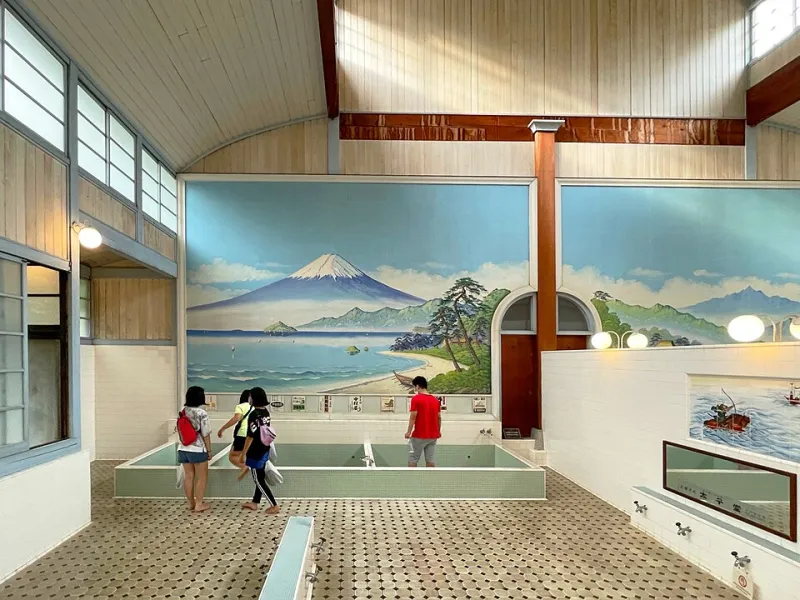
Photo: ウィキ太郎(WikiTaro), Public domain, via Wikimedia Commons
The first time I walked past a sento, I thought it was closed. The noren curtain hung limp over the entrance, the sign out front looked like it hadn't been refreshed since the Shōwa era, and the whole building glowed a faint, sleepy teal from the street. Then an old guy in a bathrobe ambled out, carrying a milk crate's worth of empty beer bottles, and I realized I'd been standing outside a neighborhood living room this whole time.
Tokyo's public baths — sento — are the anti-onsen. No ryokan booking, no sulfur springs in the mountains, no $180 bill. Just a bathhouse a few train stops from your Airbnb, open in the evening, charging pocket change, and packed with the locals who actually live around the corner. If you've done the tourist circuit and want to feel like you were let in on something, this is it.
Why 9 P.M. Is the Golden Hour
Sento used to be on every block because half of Tokyo didn't have home bathtubs. There are only around 400 left in the city now, down from thousands, and the ones that survive have evolved into something closer to a community center with hot water. Retirees come daily. Families come in waves. And the after-dinner hours — roughly 8 to 10 p.m. — are when the place hums.
That's the slot I'd point any traveler toward. The salarymen have showered off the workday, the high schoolers are done with practice, and the guy who runs the front desk has time to chat. You'll hear more unfiltered neighborhood gossip in one soak than in a week of bar-hopping. (Granted, most of it will be in rapid-fire Japanese, but you'll catch the gist. Gossip transcends language.)
The Painted Wall Is Not a Cliché — It's the Point
Walk through the changing room, past the shoe lockers and the vending machines (more on those in a second), and you'll hit the bath floor. And there, usually above the main tub, is the thing that makes every sento instantly recognizable: a mural of Mt. Fuji, painted directly on the tile, blue and white and slightly faded at the snowline.
These aren't reproductions. Many were done by the same family of painters — the Kiyoto family — across decades, and each bathhouse's Fuji is a little different. Soaking in a hot bath, staring up at a hand-painted mountain while a ceiling fan turns lazily overhead: that's the sento experience in one image. It's kitsch and sincere at the same time, which is basically Tokyo's whole deal.
Vending-Machine Beer Is a Feature, Not a Bug
Here's the part that shocks American visitors: after your bath, you sit in the lobby — sometimes on tatami, sometimes at little tables — in your bathrobe, and drink a cold beer from a vending machine. Or a milk. Yes, coffee milk after a bath is the canonical sento move, and yes, it's delicious.
The post-bath beer hits differently when your entire body has been parboiled into relaxation. This is a core part of the ritual, not an afterthought. Budget a few hundred extra yen for it and thank me later.
The Rules: Read This Before You Go
Sento etiquette isn't complicated, but it matters, because you're a guest in someone's neighborhood. The essentials:
- Wash before you soak. Fully. Shampoo, soap, rinse. The tub is shared soak water, not a bath. This is the one rule you cannot break, ever.
- Leave the small towel on your head or at the edge of the tub. Never let it touch the water.
- You will be fully naked. No swimsuits. The small towel exists for strategic coverage while walking, and that's it. Nobody cares what you look like. Truly. Within five minutes you'll forget too.
- Tattoos: check before you go. Policies vary wildly. Some sento don't care at all, others still ban them. A few have started offering cover-up stickers. Look up the specific bathhouse's policy on its website or social media — many now state it clearly. If you're heavily inked, call ahead or pick a sento known to be tattoo-friendly.
- Hair up, phone away. Long hair stays out of the water, and no phones on the bath floor, period.
That's it. Follow those five things and you'll be treated as a regular within two visits.
Finding Your Bath
Search "sento" plus your neighborhood, or use the Sento Association maps online — most major wards have one. Look for the chimney (real sento have chimneys) and the noren curtain. Entry runs around 500 yen in central Tokyo, cheaper in the outer wards. Bring a small towel and toiletries, or rent a towel at the desk. Some of the best — Koganeyu and Kōrakuen Onsen among them — have been renovated into near-design destinations with craft beer on tap, but my favorite sento are the unrenovated ones: fluorescent lights, a grumpy-but-kind okami-san at the desk, and a Fuji mural that's seen everything.
Go on a weeknight. Buy the milk. Learn the rules. And when you climb those steps back out onto an ordinary Tokyo street, hair still damp at 10 p.m., you'll understand why the locals kept the door open all these years.